Wednesday, May 28, 2014

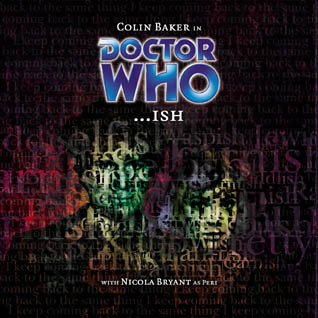
...ish

With a couple of exceptions we'll discuss later, I really didn't start listening to Big Finish until around 2004. So, when I was listening to things like "...ish", I was excitedly pouring through these audios excited to get from the awesome ending of "Neverland" to the 30th anniversary followup in "Zagreus". At this point, I was always previewing releases by checking out a web site (the Doctor Who Ratings guide which is still around) and skimming (to avoid spoilers) fan reviews of whatever I was going to listen to next. The fans seemed to really love "...ish" as a unique story, and by this point I was always excited to devour any new Colin Baker story. So, I was quite excited to check out "...ish". But, I confess I don't have much enthusiasm for this one.

Fundamentally, this is a story about language. The setup is a university where the ultimate lexicon is being assembled. To assist in this an incredibly advanced A.I. hologlyph called "Book" is used as a tool to collect all the known words of the English language. Meanwhile, the top researcher (an old friend of the Doctor's) is found dead - presumably murdered - in her locked office. And there's definitely something odd about Book.

For lovers of the English language, there is a lot to love here. Your vocabulary will be stretched to its absolute limits listening to this audio (more like ripped apart in my case). It was clearly written by a very clever man. And, the character of Book is quite creepy and the audio effect for his voice is terrific. There is some clever humor here too, and I am particularly amused during the parts where the titular suffix is temporarily censored.

But, ultimately for me, the central premise of the "Omniverbum" just doesn't resonate with me. Science Fiction, to me, is really just plausible sounding fantasy. And, this concept just doesn't ring true to me. I had trouble wrapping my head around it, and once I (thought) I did, I just thought it was silly. So while I was intrigued by "...ish" for its first half, the explanation just came off as nonsensical and (even worse) unbelievable to me. Author Phil Pascoe even admits the plot doesn't really make sense.

On my most recent listen I did enjoy this slightly more than way back in 2004, ten years ago. So, while this has been among my least favorite Big Finish stories for a decade, it did come off a little better than I had remembered it. I appreciate the cleverness of the dialog, which is loaded with all the color you could imagine being squeezed out of the English language. I also enjoy the change in attitude the Doctor shows in the American colloquialisms of English by the end of the story. Still, I can't muster up the same enthusiasm fans had for this story a decade ago. A well acted, and clever story, that I just fail to enjoy as much as I might wish to.

Rating: OK

Sunday, April 20, 2014

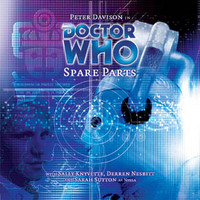
Spare Parts

Back in the days before Doctor Who's return to TV in 2005, figuring out how to introduce someone to the show was an interesting challenge. You generally, would try to think of one of the all time great stories, that wasn't too long, and didn't require a lot of previous knowledge of the show. I would guess most of us didn't put "An Unearthly Child" high in the list of candidates, given its age and well... it isn't that great. Generally we picked a Tom Baker story like "Pyramids of Mars", "City of Death", or "The Deadly Assassin". Or maybe we went for the action packed "Caves of Androzani". Either way, showing some new initiate often involved putting in a DVD, and expecting them to sit through 4 (or more) episodes of Doctor Who. Often the poor victim of our enthusiasm had mentally checked out by the mid-point of the first episode. Now, with the new show mostly contained in faster paced 45 minute stories, there is one fairly obvious episode to pick to try to hook a new viewer into becoming a fan. (Hint: it rhymes with "sink".)

So, how do you introduce someone to the Big Finish range of Doctor Who? Well, for starters, I don't recommend introducing someone who isn't already a fan of Doctor Who. Seriously, as much as I adore Big Finish and consider it to generally represent the pinnacle of Doctor Who storytelling, I can't imagine selling Doctor Who in audio format first. (I am sure it's worked for some people, but I would guess they are a small exception.) This requires someone who is already a fan of the classic show, which generally is almost a requirement for Big Finish given the number of story lines, villains, and references littered throughout the range to the original series. (After all it is by fans, for fans.) So, you pick some of the iconic and best stories. So, in our reviews so far my list would look something like "The Marian Conspiracy", "The Holy Terror", "The Chimes of Midnight", and most definitely "Spare Parts".

This story is to Cybermen what "Genesis of the Daleks" was to Daleks - essentially, an origin story for people already familiar with the "monster". This is a masterpiece by Marc Platt who prior to Big Finish was pretty much only known by me for writing the entertaining mess that was "Ghost Light" in the final McCoy TV season. To say that I like this more would be a great understatement. This is a dark, depressing story (as you might expect) and remains one of my all time favorite Doctor Who adventures.

As you might guess, this takes place on Mondas, the original home planet for the Cybermen. When the 5th Doctor and Nyssa arrives, the Doctor figures out pretty quickly where (and when) they are. Realizing that he can't really risk trying to change what happens here in this pivotal time in the planet's history he attempts to persuade Nyssa that they should leave right away. Somehow, Nyssa, convinces him to hang around a bit, which may be the biggest flaw in the story. Quickly they get separated, and they get caught up in the catastrophic events.

As any devoted Doctor Who fan might expect the voices of these "not quite Cybermen" are done in the style of their debut story "The Tenth Planet". When I finally first saw the story for myself I found the voices both ridiculous and disturbing all at once. My opinion hasn't altered much from this audio, although the disturbing factor is higher here. Of course Nick Briggs does a sensational job doing the voice work.

The best decision Platt made in this story was NOT to try to create another Davros for the Cybermen. Doctorman Allan, the ostensible "creator" of the Cybermen is not some deranged lunatic. She's a desperate, flawed woman. She's brilliant but also drinks too much. She's full of despair at where they are in their dire situation and has serious doubts about their solution, but knows the alternative is extinction.

Probably the best moment in the story comes from Nyssa meeting the downtrodden Hartley family. After befriending Yvonne and her dad, and meeting the less pleasant brother Frank, she quickly realizes the dire straits the family (and the planet) lives in. When Yvonne is selected for the "work crews" and then ultimately returns, it's one of the most gut wrenching scenes in the history of Doctor Who. The performance for Yvonne and the Hartley family is just tremendous and it is simply heart breaking.

The other terrifying aspect of the story is the dreaded Committee that is truly running the show on Mondas. Their internal dialogs are quite creepy (and hard to understand at times as well). One particularly long internal dialog that results in them uttering the dreaded "We must survive" line over and over again fills the listener with dread.

Quite simply, this is a tremendous story, which I don't really want to get into much more for fear of giving too much away. If you haven't heard "Spare Parts" yet, you simply must buy it now. If you have heard it, it's probably long since time you listened to it again. The Doctor and Nyssa are put through the emotional (and physical) ringer. The Doctor ends up playing a pivotal role in the story (both in ways you would expect and not expect) and when he and Nyssa leave thinking they may actually have made a difference, you'll hang around for the last couple of minutes and find out just how wrong they were.

Rating: CLASSIC
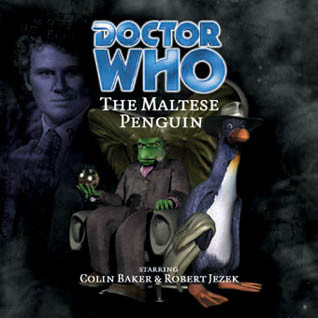
The Maltese Penguin

Technically, this CD shouldn't be included in my reviews. I try to stick with the monthly releases only (when I can bother to remember this blog exists), but given this single CD title was given the number 33 and 1/2, I include it in the section of the CD case that contains the monthlies. This title was given away free with Doctor Who Magazine back in July of 2002. Back in the 2003-2004 time frame when I was gobbling up Big Finish for the first time, I was very excited to hear this one. It features Colin Baker's Doctor (already at this point becoming a favorite for me), Frobisher, and was written by Rob Shearman. The last time we were served up this combination, we got the completely awesome "Holy Terror", so needless to say, I has high expectations.

Well, let's cut to the chase - this isn't nearly as good. If you don't believe me, just ask Rob Shearman, who calls this the worst thing he wrote for Big Finish. Ouch! (I disagree by the way. He's written worse. Ouch, again!) Shearman thinks it's a funnier script on paper than for an audio play. I think it's more amusing than funny, but I think he's a bit too harsh in his criticism of this. This story is a cute satire on the old film noir, hard boiled detective stories. Frobisher is the star of the story, and the Doctor only shows up at a few points in the story (while still managing to save the day). However, that doesn't mean you don't hear a lot of Colin Baker - quite the contrary!

Robert Jezek returns to play Frobisher, but for the most part, he serves as Frobisher narrating the story in the aforementioned film noir style. In a funny twist, the shape changing Frobisher actually spends most of the story in the form of ... the Doctor. So, we trade Jezek's unconvincing New York accent for Colin Baker's (hopefully intentionally) even less convincing New York accent! Actually, Colin is a lot of fun as Frobisher.

Most of the humor comes from laughing at the cliches of the genre and the story's silly over the top characters. Most of my enjoyment of this story comes from the moments the Doctor shows up in the story to see if Frobisher is ready to return traveling in the TARDIS. (Frobisher, is busy proving he can survive without the Doctor in his day job as a private detective.) It's really quite sweet for the Doctor to keep showing up and warmly greeting Frobisher. It's clear the Doctor is lonely and misses his friend. This is such a sweet development for the 6th Doctor and would be unbelievable to imagine the TV version of this Doctor doing this.

So, while there are a few chuckles, it's not really a hilarious story. Thankfully, this isn't dragged out across two CDs or my opinion would probably be much lower. Really, this is a harmless bit of silly fun. It's actually a nice change of pace between the epic finale of "Neverland" and before the incredible, but doom laden "Spare Parts".

Rating: OK

Wednesday, April 24, 2013

Neverland

This is the epic conclusion to the mostly excellent second season of adventures featuring the 8th Doctor and Charley. It also provides answers and resolution for Charley's story arc related to her not dying when she should have in "Storm Warning" and the consequences to the web of time that the Doctor's intervention has caused. This is also epic in length, as they crammed about every second they could onto each CD. The story ran so long they had to remove the mid disc episode breaks, which does make this feel even longer. Having said that, it is a truly satisfying conclusion to a great story arc, and endows the hardcore Doctor Who fan with tons of Time Lord history and lore. This one is definitely for the fan boys!

We learn that Charley not dying when she was supposed to, has created a breach between the normal universe and an anti-verse made up of beings of anti-time. The incursion of these beings of anti-time is not a friendly one and the universe and the entire web of time are at stake. The intro consists of voices in the matrix reciting various points in history from different times and places only to end with the voices getting confused and crying out that they can't remember. It's a chilling intro that makes it clear that things are very wrong. The Doctor and Charley are pursued and ultimately captured by Romana and the Time Lords. They end up using Charley to travel to this anti-verse, where they meet the Neverpeople of anti-time. They also seem to find a lost TARDIS of Rassilon himself along with his "remains" in a casket. Or is it all a sinister plot by the Neverpeople?

There are many highlights to this tale. When the Doctor is shown a possible future of Gallifrey due to all the havoc being played to the time line where Romana is a dark Imperatrix who coldly sentences the entire Dalek race (still trapped in the vortex after the events of "Time of the Daleks"), it is a truly chilling scene. The performance of India Fisher as Sentris - the chief Neverperson - who has adopted Charley's form is fantastic. She pitches her voice a bit lower and with a little added effects sounds like quite an evil bastard! The discovery of Rassilon and his recording imploring his people to return him home feels hugely momentous. Finding out that the Neverpeople are in fact Time Lords who were erased from history in barbaric (and often unjust) executions is a nice revelation. Perhaps the episode's best highlight is the brilliant scene where Sentris gives the Doctor the chance to save the entire universe, except he has to kill Charley to do it. It's a gut wrenching scene, where Charley begs him to do it, but of course the Doctor won't. It was also quite momentous to hear the Doctor tell Charley that she's his friend and he loves her. You just didn't get this kind of closeness on the classic series, and before the new series' return in 2005, this was really breaking new ground in the Doctor/companion dynamic. It's also lovely when the Doctor, just before sacrificing the TARDIS and himself to save the day, is scooped into the Matrix by Rassilon to discuss what's happened. Here it is revealed who the Doctor was talking to during the narration bits of "Seasons of Fear". It's interesting how benevolent the portrayal of Rassilon is here (and it should be said, Don Warrington's majestic voice gives Rassilon all the majesty you would expect), given how things would go in the future.

But perhaps all of that pales beside the story's thrilling ending and shocking cliffhanger. When the Doctor (corrupted by the explosion of anti-time trapped in the TARDIS) actually strikes Charley and then bellows, "I am Zagreus!" it still gives me goosebumps. Having come into Big Finish in 2004, I can only imagine what it would have been like to wait for months after this for the 30th anniversary followup "Zagreus" in 2003. (Much more on that story, later...) "Neverland" in many ways represents Big Finish at its story telling best. The wonderful references to Zagreus in multiple Doctor Who stories, the teasing that Charley's survival was going to cause problems - it all gets tied up beautifully here. It's also a delight when the Doctor and Romana briefly team up and plot against the Neverpeople. It really feels like old times, which never quite happened in their reunion in "The Apocalypse Element". Are there problems? Sure, there are way too many talky scenes that stretch on and on. We really could have done with some trimming and having the normal episode breaks. Still, this story is a triumph, and punctuates how effective a pairing the Doctor and Charley are. Sadly, things will never be the same after this...

Rating: CLASSIC

Wednesday, January 2, 2013

Happy New Year!

Happy 2013 everyone! I apologize for the lack of updates. Both familial obligations, holiday happenings, and an excessive amount of adult beverages kept me from updating the blog for the past couple of weeks. Updates should resume this week with "Neverland" and "The Maltese Penguin".

I greatly enjoyed this year's Christmas Special. My favorite Christmas special was "A Christmas Carol", and my least favorite was last year's. This one was pretty great, with the Clara mystery kicking into high gear. Jenna Louise Coleman is mesmerizing so far, and I can't wait to find out what "the deal" is with Clara! I assume that mystery will be the story arc of season 7 (and hopefully be resolved at or by the end). It was cute bringing back The Great Intelligence. I felt bad for Richard Grant - who was terrific - but mostly pushed to the sidelines. Still thumbs way up from me and one of the top 2 or 3 Christmas Specials.

On another note, tomorrow morning I will finally get to hear the first new story in around 30 years for my childhood favorite Doctor, as I will finally be starting on the Tom Baker audios with "Destination Nerva"! Look for a review in the far future here. For now we'll stick with the monthlies....

Tuesday, December 18, 2012

Time of the Daleks

Ugh.

Oh you want more?

I am a fan of Justin Richards' other Big Finish stories (particularly "Whispers of Terror") but this one really just doesn't work for me. This is Paul McGann's first interaction with the Daleks, in a mind bending time paradox story, that drags on a little too long, and is a bit too convoluted for my brain to figure out. The gist of the story is that William Shakespeare is disappearing from history (the Doctor mentions him and Charley has no idea who he is talking about). The Doctor figures out the cause for this potential rewriting of history is happening (mostly) in the 21st century a few decades from now. A British General (who has "temporarily" seized control of England (for the greater good) is engaged in time experiments and getting some help from... the Daleks!

The story is basically built around a time paradox involving the Daleks getting stuck in the time vortex. They send three Daleks to sort the mess out and they arrive in England. Once the Daleks attempt to escape and execute their fiendish plan, the Doctor intervenes, causing the Daleks to get stuck in the time vortex - which is of course how the story began. Rinse, lather, repeat. I know paradoxes don't really make sense to begin with, but this one really doesn't make sense to me.

My other big issue with this story is the science behind the time travel experiments. Basically, they have figured out how to time travel using a lot of mirrors and a lot of clocks - along with a Master Clock. Terrance Dicks once said in a DVD extra that you could have the most improbable science you want in Doctor Who as long as you make it sound plausible. (I am sure I am paraphrasing this horribly.) This rubbish with the mirrors just doesn't come off as plausible to me, at all, which disengages me from the story early on. Now, is this Richards' fault, or I am just a simpleton? Fans of this story can let me know how stupid I really am.


There are some good points. Listening to the Daleks quoting Shakespeare is at once both silly and creepy. At times one undermines the other, but usually the combination works quite well. There is certainly a lot of action here with gun fights galore. We also finally get the explanation as to why the Dalek was dropped right into the middle of episode 1 of "Seasons of Fear" - though I think it was silly that the other one was dropped off randomly into World War II. They should have sent that one into "Invaders from Mars" instead! Finally, the twist with Shakespeare is a cute surprise. Although the next Big Finish with Shakespeare (it will be a while before we get to that one) is far stronger and has a much better twist!

At the end of the story, the Doctor finally acknowledges that too many odd time anomalies and paradoxes have been swirling around them. He finally admits that it's time to do something about Charley. This leads nicely into the big season finale "Neverland". I appreciate some of the clever ideas in this story. Perhaps these ideas are just a bit too clever for me to appreciate, but I mainly just find most of this story ponderous to listen to.

Rating: OK

Thursday, December 13, 2012

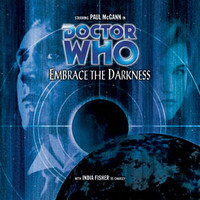
Embrace the Darkness

"Embrace the Darkness" (written and directed by Nick Briggs) is, for me, a tale of two halves. The first half is a wonderfully creepy story of a base of humans on an alien planet assaulted by the terrifying indigenous life forms who drain all the light from their base and then horrifically burn out their eyes. The second half is where we find out that maybe these creatures aren't the monsters they seem and a set of alien invaders is on the way to wipe everyone out. The first half of the story is the more effective half. It's a genuinely scary sci-fi story reminiscent of Alien (or Aliens). The second half seems to move more slowly with a certain lack of urgency.

The opening scene of this story is tremendous. We join a base staffed by three humans on the fourth planet of the Cimmerian system. The planet is rich with minerals and seemingly has no local inhabitants. Since the Cimmerian system has a burnt out sun, the crew is there to set up some "Energy Projection Units" which will act as an artificial sun - making the planet ripe for exploitation. The three crew members have a nice informal relationship and in a short scene we hear some lovely banter between them. This serves to make them quite likable in a short period of time, which makes the horror which befalls them all the more effective. Just before they are about to activate the EPUs , tremors shake the base to its foundations. Then the lights begin to dim until they are in utter darkness. Then the locals arrive and the three visitors begin to scream in terror and pain. The actors really give it their all here, and the sound effects and music really help to make this scene terrifyingly effective. The Cimmerians' lone dialog in this scene, "Embrace the darkness," is delivered in a creepily menacing whisper. And, we're off to a fantastic start!

The Doctor and Charley are whizzing along in the TARDIS, when the Doctor spots a veritable armada of (fancier) Type 70 TARIDSes ahead of them in the vortex. He briefly mulls the idea of meeting up with them and saying, "Hello", but of course that's not really his style. So, he quickly changes course. They arrive in the Cimmerian system, which the Doctor notes is famous for having a sun which inexplicably went dark. They begin drifting forwards and backwards in time to see if they can figure out what caused this mystery. When the TARDIS accidentally fully materializes in the Cimmerian system, they are immediately intercepted by a craft piloted only by a computer AI named ROSM embodied by several robots who has been sent to rescue the three crew members on the planet. ROSM is at times both menacing and laughable as a ruthless, but also often inept AI. The main threat from ROSM is that he wants to kill Charley because she has all sorts of dangerous, unknown, malignant cells that ROSM detects in a scan. The Doctor explains this away as carcinogenic precancerous cells normal for the time period she is from, but astute followers of the season arc may wonder if there's more to it than that. These same fans of the story arc may also wonder why a fleet of TARDISes was in the time vortex seemingly in the Doctor's path...

The Doctor manages to dupe and distract ROSM enough for Charley to inadvertently elude termination by taking an escape pod to the planet. What follows is various encounters with the traumatized crew and the local inhabitants. As noted before the first half is lovely and creepy. The three crew are very well played by the actors who react to their trauma in varying ways. Charley also is threatened by these Cimmerians more than once but manages to narrowly avoid having her eyes burned out. In the second half of the story we find out these aliens aren't the sadistic torturers they seem, and they suddenly become quite chatty about who and what they are.

When the new alien threat arrives which will seemingly kill both the Cimmerians, ROSM, and humanoids alike is when the story takes a downward turn for me. First off, there seems to be a lack of urgency about their imminent death. The idiotic ROSM keeps insisting on tons of safety and flight checks which delays the humans escaping in their craft seemingly forever. The Doctor meanwhile is riddled with guilt over putting them all at risk by his actions and blames himself for the death of one of the Cimmerians, which is ridiculous. His actions are totally justifiable given the Cimmerians wait until the new alien invaders are about to wipe them out to bother communicating lucidly with their visitors. And, the Doctor has nothing to do with the Cimmerian's death! All of this just annoys me as the Doctor and the Cimmerians sit around for a long time chatting with each other, instead of dealing with the impending alien threat. All of this calamity could have been avoided if the Cimmerians had been a little more communicative in the first 3/4 of the story. Finally, when we confront the aliens near the end, the revelation of who they are is a nice twist, but it leaves the ending a little flat. Plus, the revelation lacks some explanations which makes the story seem a bit illogical.

Still, while I don't love the end of the story, it's pretty fun as a whole. The music and sound design do a really great job of establishing the creepy atmosphere. ROSM is a fun source of both threat and comic relief. While the second half doesn't work as well for me, others may appreciate the clever twist more than I do. Apparently, McGann was exhausted when they recorded this, but it doesn't come through in his performance at all - a testament to both McGann and Briggs. I wouldn't call this the high point of this great season, but I also wouldn't call it the low point. Briggs over the years has proven that he's very adept at producing these futuristic space opera type stories. He has a knack for nailing the atmosphere and sound effects. While this isn't his best story, it's perfectly solid and entertaining.

Rating: Good