Tuesday, December 18, 2012

Time of the Daleks

Ugh.

Oh you want more?

I am a fan of Justin Richards' other Big Finish stories (particularly "Whispers of Terror") but this one really just doesn't work for me. This is Paul McGann's first interaction with the Daleks, in a mind bending time paradox story, that drags on a little too long, and is a bit too convoluted for my brain to figure out. The gist of the story is that William Shakespeare is disappearing from history (the Doctor mentions him and Charley has no idea who he is talking about). The Doctor figures out the cause for this potential rewriting of history is happening (mostly) in the 21st century a few decades from now. A British General (who has "temporarily" seized control of England (for the greater good) is engaged in time experiments and getting some help from... the Daleks!

The story is basically built around a time paradox involving the Daleks getting stuck in the time vortex. They send three Daleks to sort the mess out and they arrive in England. Once the Daleks attempt to escape and execute their fiendish plan, the Doctor intervenes, causing the Daleks to get stuck in the time vortex - which is of course how the story began. Rinse, lather, repeat. I know paradoxes don't really make sense to begin with, but this one really doesn't make sense to me.

My other big issue with this story is the science behind the time travel experiments. Basically, they have figured out how to time travel using a lot of mirrors and a lot of clocks - along with a Master Clock. Terrance Dicks once said in a DVD extra that you could have the most improbable science you want in Doctor Who as long as you make it sound plausible. (I am sure I am paraphrasing this horribly.) This rubbish with the mirrors just doesn't come off as plausible to me, at all, which disengages me from the story early on. Now, is this Richards' fault, or I am just a simpleton? Fans of this story can let me know how stupid I really am.


There are some good points. Listening to the Daleks quoting Shakespeare is at once both silly and creepy. At times one undermines the other, but usually the combination works quite well. There is certainly a lot of action here with gun fights galore. We also finally get the explanation as to why the Dalek was dropped right into the middle of episode 1 of "Seasons of Fear" - though I think it was silly that the other one was dropped off randomly into World War II. They should have sent that one into "Invaders from Mars" instead! Finally, the twist with Shakespeare is a cute surprise. Although the next Big Finish with Shakespeare (it will be a while before we get to that one) is far stronger and has a much better twist!

At the end of the story, the Doctor finally acknowledges that too many odd time anomalies and paradoxes have been swirling around them. He finally admits that it's time to do something about Charley. This leads nicely into the big season finale "Neverland". I appreciate some of the clever ideas in this story. Perhaps these ideas are just a bit too clever for me to appreciate, but I mainly just find most of this story ponderous to listen to.

Rating: OK

Thursday, December 13, 2012

Embrace the Darkness

"Embrace the Darkness" (written and directed by Nick Briggs) is, for me, a tale of two halves. The first half is a wonderfully creepy story of a base of humans on an alien planet assaulted by the terrifying indigenous life forms who drain all the light from their base and then horrifically burn out their eyes. The second half is where we find out that maybe these creatures aren't the monsters they seem and a set of alien invaders is on the way to wipe everyone out. The first half of the story is the more effective half. It's a genuinely scary sci-fi story reminiscent of Alien (or Aliens). The second half seems to move more slowly with a certain lack of urgency.

The opening scene of this story is tremendous. We join a base staffed by three humans on the fourth planet of the Cimmerian system. The planet is rich with minerals and seemingly has no local inhabitants. Since the Cimmerian system has a burnt out sun, the crew is there to set up some "Energy Projection Units" which will act as an artificial sun - making the planet ripe for exploitation. The three crew members have a nice informal relationship and in a short scene we hear some lovely banter between them. This serves to make them quite likable in a short period of time, which makes the horror which befalls them all the more effective. Just before they are about to activate the EPUs , tremors shake the base to its foundations. Then the lights begin to dim until they are in utter darkness. Then the locals arrive and the three visitors begin to scream in terror and pain. The actors really give it their all here, and the sound effects and music really help to make this scene terrifyingly effective. The Cimmerians' lone dialog in this scene, "Embrace the darkness," is delivered in a creepily menacing whisper. And, we're off to a fantastic start!

The Doctor and Charley are whizzing along in the TARDIS, when the Doctor spots a veritable armada of (fancier) Type 70 TARIDSes ahead of them in the vortex. He briefly mulls the idea of meeting up with them and saying, "Hello", but of course that's not really his style. So, he quickly changes course. They arrive in the Cimmerian system, which the Doctor notes is famous for having a sun which inexplicably went dark. They begin drifting forwards and backwards in time to see if they can figure out what caused this mystery. When the TARDIS accidentally fully materializes in the Cimmerian system, they are immediately intercepted by a craft piloted only by a computer AI named ROSM embodied by several robots who has been sent to rescue the three crew members on the planet. ROSM is at times both menacing and laughable as a ruthless, but also often inept AI. The main threat from ROSM is that he wants to kill Charley because she has all sorts of dangerous, unknown, malignant cells that ROSM detects in a scan. The Doctor explains this away as carcinogenic precancerous cells normal for the time period she is from, but astute followers of the season arc may wonder if there's more to it than that. These same fans of the story arc may also wonder why a fleet of TARDISes was in the time vortex seemingly in the Doctor's path...

The Doctor manages to dupe and distract ROSM enough for Charley to inadvertently elude termination by taking an escape pod to the planet. What follows is various encounters with the traumatized crew and the local inhabitants. As noted before the first half is lovely and creepy. The three crew are very well played by the actors who react to their trauma in varying ways. Charley also is threatened by these Cimmerians more than once but manages to narrowly avoid having her eyes burned out. In the second half of the story we find out these aliens aren't the sadistic torturers they seem, and they suddenly become quite chatty about who and what they are.

When the new alien threat arrives which will seemingly kill both the Cimmerians, ROSM, and humanoids alike is when the story takes a downward turn for me. First off, there seems to be a lack of urgency about their imminent death. The idiotic ROSM keeps insisting on tons of safety and flight checks which delays the humans escaping in their craft seemingly forever. The Doctor meanwhile is riddled with guilt over putting them all at risk by his actions and blames himself for the death of one of the Cimmerians, which is ridiculous. His actions are totally justifiable given the Cimmerians wait until the new alien invaders are about to wipe them out to bother communicating lucidly with their visitors. And, the Doctor has nothing to do with the Cimmerian's death! All of this just annoys me as the Doctor and the Cimmerians sit around for a long time chatting with each other, instead of dealing with the impending alien threat. All of this calamity could have been avoided if the Cimmerians had been a little more communicative in the first 3/4 of the story. Finally, when we confront the aliens near the end, the revelation of who they are is a nice twist, but it leaves the ending a little flat. Plus, the revelation lacks some explanations which makes the story seem a bit illogical.

Still, while I don't love the end of the story, it's pretty fun as a whole. The music and sound design do a really great job of establishing the creepy atmosphere. ROSM is a fun source of both threat and comic relief. While the second half doesn't work as well for me, others may appreciate the clever twist more than I do. Apparently, McGann was exhausted when they recorded this, but it doesn't come through in his performance at all - a testament to both McGann and Briggs. I wouldn't call this the high point of this great season, but I also wouldn't call it the low point. Briggs over the years has proven that he's very adept at producing these futuristic space opera type stories. He has a knack for nailing the atmosphere and sound effects. While this isn't his best story, it's perfectly solid and entertaining.

Rating: Good

Monday, December 10, 2012

Seasons of Fear

Here we have a time traveling (and time bending) romp where The Doctor and Charley travel to various points in time to thwart the plans of the villainous Sebastian Grayle. How exactly did they set out on this quest to stop Grayle, you ask? Well, the Doctor has (apparently) finally managed to get Charley to Singapore to make her date with Alex (which was her original planned destination when she boarded the doomed R101 airship). While Charley is off with Alex, a strange man named Grayle comes and speaks to the Doctor. He is here to gloat, letting the Doctor know that in his (the Doctor's) personal future Grayle will be responsible for his death. Grayle's masters were able to conquer the Earth - and then all of space and time, with Grayle's help. This is all in spite of constant interference from the Doctor which made him Grayle's most bitter enemy. Now having won, Grayle's masters have created this fake timeline just so he can taunt the Doctor over his impending failure and doom. It's a bit of a mind bending setup, and I assure you, your mind will be even further bent by the end of this tale. Written by Doctor Who stalwart Paul Cornell and his wife (though it may have been fiance at the time) Caroline Symcox, this is a really fun story.

Of course, the Doctor immediately corrals Charley and they set off to find out what Grayle's plans are (or were). At one point when Charley points out to the Doctor that this may be why and how Grayle ends up killing the Doctor, he of course brushes her off in amusing fashion. After a bit of Time Lord technobabble, the Doctor manages to find Grayle in 305 AD. Grayle is about to allow his alien masters to invade by means of a sacrifice. After the Doctor and Charley thwart his plans (but not before Grayle is given an extremely long lifespan from his alien benefactors) Grayle vows revenge. Our heroes then track him to the court of Edward the Confessor some 750 years later. Once again the Doctor manages to sabotage Grayle's plans to allow his masters to arrive on Earth. Once again the Doctor and Charley travel another 750 years farther in time to 1806, only this time Grayle's plan succeeds and the aliens land. And now, the Doctor's troubles really begin!

One of the fun parts of the story is figuring out who Grayle's mysterious aliens are. There is a lovely red herring thrown into episode one to lead you down the wrong path, although it's really just a link to a future story in the season. Grayle does give a lot of subtle hints about who these aliens may be. And then, a few minutes before their arrival a blatant hint is given about their identity. I confess I had no idea until I heard this more blatant clue, and even then I wasn't quite sure I believed it. When these aliens show up (and yes, of course they are from the show's past) it's a delightful, goose bump inducing surprise. It's true that I don't find the final fourth episode after the invaders arrival quite as engaging as the previous three, but the resolution is pretty satisfying in a Doctor Who, timey-wimey, break your brain kind of way!

The guest cast is highlighted by Stephen Perring playing the twisted Grayle. The development of the character is pretty interesting to observe throughout the centuries, as he gets more and more ruthless. It's also pretty fun listening to him get more and more angry as the Doctor keeps interfering in his plans. In the final episode you can really feel the difference between the Grayle of 305 AD and the Grayle who has lived for over 1500 years. It's a great performance by Perring. Also of note are Lennox Greaves and Sue Wallace (who we just heard in different roles in "The Chimes of Midnight") playing Edward and Edith. You definitely recognize Greaves' voice from the previous story, but both of these actors' performances are splendid and quite different from the butler and cook of the previous play.

Once again the production stands out as excellent. The music by Jane Elphinstone is particularly memorable. At the ends of the first 3 episodes, the same musical refrains are played which slowly but surely build up the tension to the cliffhangers. Also, it must be said that when the alien invaders finally arrived, the voice effects are just perfect and sound exactly like those used on the TV show decades ago.

This story also carries along the season long arc involving Charley's non-death on the R101. Throughout the story we hear the Doctor narrating the events of this tale to someone unknown. (This helps with some quick exposition at times, but also happens before a couple of the cliffhangers which really undermines them. Look, we all know that the Doctor isn't really going to be killed at the end of an episode - at least most of the time. But, having the Doctor discuss the cliffhanger a few seconds before it happens really removes any sense of danger.) The unnamed listener does speak a little near the end of the tale, and it certainly leaves the listener wondering who the Doctor is talking to and where the Doctor is. Of course, this all gets paid off later. But, the most fun happens in the story's final scene. Suffice it to say, a clear threat is established to the Doctor and Charley, and we finally know that the Doctor is going to have to pay a price for saving Charley's life. In other words, it is so ON! This story is yet another true highlight of an amazing season of Doctor Who. I can't quite rate it as highly as "The Chimes of Midnight" but this still remains one of my favorites.

Rating: Great

Sunday, December 2, 2012

The Chimes of Midnight

Here we have the second story from Robert Shearman whose Big Finish debut, "The Holy Terror" was a magnificent classic. Could Shearman possibly match or even better his debut? The answer is a resounding yes. In most fans' lists of favorite Big Finish stories, "The Chimes of Midnight" tops or lingers near the top of almost all of them. It's a magnificent story which really gets the Charley arc going into high gear in this second season of 8th Doctor audios.

The Doctor and Charley arrive in a stately manor on Christmas Eve in the early 20th century. The story takes place in the servant quarters, where whenever the chimes strike the hour, one of the servants is murdered. Except after midnight, everything seems to go back to 10 o'clock, and the murders start over again, but they aren't played out in the same way. The Doctor and Charley are absorbed into this repeating drama as sleuths trying to solve the murders. Things are definitely not right here, and the whole thing may revolve around Charley! There's much, much more to the plot than this, but I really want to avoid spoiling it for anyone who hasn't yet heard this amazing story.

Much like "The Holy Terror" before it, this is a very dark, creepy story with some touches of black humor. There aren't really the crazy laugh out loud moments in this story, but you may chuckle a few times. It can't be stressed enough how incredible the production of this story is. Barnaby Edwards makes his Big Finish directorial debut, after appearing in several previous Big Finish stories, and does a tremendous job with this complex script. He and Andy Warwick who handled sound design create such a brilliant, spooky atmosphere, along with emphasizing all of the odd time anomalies with impressive sound effects. From the always present ticking of the grandfather clock to the eerie (and always identical) scream whenever a murder takes place, the listener just gets sucked completely into this story's world and the time flies by as you listen to it.

The cast is in top form as well. Lennox Greaves (who was in "The Shadow of the Scourge") is terrific as the stuffy butler Shaughnessy, and suitably menacing as Edward Grove. Sue Wallace is perfect as the high and mighty cook Mrs. Baddely. And, Louise Rolfe is haunting as the poor scullery maid Edith. Again Edwards does a perfect job of managing the cast as they play the characters who keep reacting to these murders in decidedly odd ways.

Shearman explores many themes of the serving class vs the upper class. Repeatedly the characters describe themselves as "nothing". The upstairs is described as a forbidden place and then it becomes quite literally forbidden when the Doctor tries to venture upstairs. The way these characters transition from charmingly odd, to completely menacing is amazing. It's a very complicated balancing act this story accomplishes, juggling the scares with the odd humor, but it's done here to perfection.

This story is amazing. Now having heard it a few times, I can say without reservation that it's one of the finest Doctor Who stories ever told. It stands alone as an incredible adventure (though knowing a bit about Charley's introduction definitely helps), but it also fits into the season long arc perfectly. Shearman, who wrote the story under incredible stress, was sure that Gary Russel would reject the script. Perish the thought! It stands out as the best story in a very strong season of Doctor Who.

Rating: CLASSIC

Thursday, November 29, 2012

Invaders From Mars

This is the second Big Finish Doctor Who written by Mark Gattis, and this time Mark also directed the play. The plot is based on a very clever idea of real aliens actually causing mayhem in New York during the legendary Orson Welles radio broadcast of "The War of the Worlds". Some of this audio drama was presented in the form of mock news casts, which actually fooled many listeners into thinking there was a real alien invasion going on! It also has the novel idea of the invading aliens being technologically superior, but pretty much comically useless. The story has a mix of serious and silly tones to it. It's a fun story, but I can't help thinking that releasing this story right after the totally comedic "The One Doctor" didn't do this play any favors. This story also marks the beginning of the 2nd Big Finish season of 8th Doctor audios. While the quality of story varies somewhat from one release to another, this season really pays off the character arc of Charley, who we all know should have died back in "Storm Warning", but the Doctor saved her, changing history. The consequences of this really come back to haunt him. Back when this was the only new Who I was just blown away by this season, and this story gets it off to a nice, fun start.

Gattis assembled quite an impressive cast for this play. David Benson does a very impressive Orson Welles impersonation (to my ear anyway), and is very entertaining throughout. Simon Pegg (famous for many things - not the least of which going on to play the Editor in the new series story "The Long Game") and his co-star from "Spaced" Jessica Stevenson (who would go on to play Joan Redfern in the fantastic Series 3 Doctor Who story "Human Nature") were both brought on board to play Don Chaney and Glory Bee respectively. I would never, ever have recognized their voices with their different accents! It's funny that the first 8th Doctor story of this season would be set in America given how atrocious the accents were in the previous story "Minuet in Hell". It's true that there are some cringe inducing accents here and there, but the cliche'd New York accents largely work well in establishing the period and tone of the story, so it's far less annoying than in the aforementioned release.

Of course this story also reunites McGann and India Fisher as the Doctor and Charley, and their wonderful friendship gets explored more this season. It's funny how the 8th Doctor leaps right into the fray by impersonating the recently murdered detective Halliday, ticking Glory Bee, who in turn tricks him into finding Professor Stepashin. Another source of amusement is the evil and flamboyant villain Cosmo Devine, played by John Arthur. Devine is quite amusing, and it was certainly evidence of how Big Finish was pushing the envelope by having a homosexual villain (this was years before we had ever heard of Captain Jack). In fact, there are a few gay characters in this play! One notable cameo was by Katy Manning (who of course played Jo Grant). We'll eventually cover Manning playing Iris Wildthyme (although I am not exactly looking forward to it)!

So we have "War of the Worlds", mobsters with alien guns, Nazis, CIA, and real aliens! It's a lot to pack into this mad play. The aliens themselves are quite the double act. They are pretty comically inept, with one wanting to go off killing and destroying everything, with the other being the "smarter" of the pair wanting to catalog and learn about the planet. Of course, neither of them is bright at all, and it's amusing how quickly the Doctor works out that they are merely small time mobsters themselves trying to run a protection racket on a planetary scale. Devine's interactions with them and his (mostly successful) manipulation of them are quite amusing as well.

So, I enjoy this story as a whole, but I do sometimes find the mix of serious, scary, and humorous tones to sometimes clash and undermine the plot. I also find the musical bumpers, which are very reminiscent of radio dramas of the era to be somewhat of a distraction. I know they are using them to help set the period, but I find it takes me out of the story and makes it harder for me to take the less humorous parts of the story seriously. Still, while I don't enjoy this as much as Gattis' first story "Phantasmagoria", it's still a lot of fun, and kicks off a great second season of the 8th Doctor in style.

Rating: Good

Monday, November 26, 2012

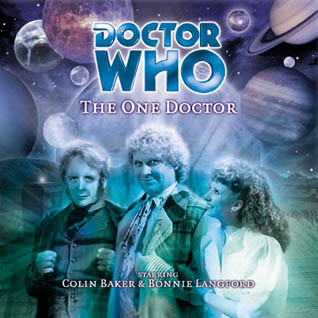
The One Doctor

Certainly, there has been plenty of humor in the current and classic series of Doctor Who. This story, which was the first by Big Finish to reunite Colin Baker and Bonnie Langford as the 6th Doctor and Mel, is an outright silly story. It was brave of Big Finish to commission such an outright funny story where the plot is just a means to a comedic end. But, the story works brilliantly and is peppered with many laugh out loud moments.

The plot centers around a con-man (and his female partner in crime) pretending to be the Doctor. He and his "companion" show up on a planet where they create a hoax invasion which of course "The Doctor" repels. After much cajoling "The Doctor" reluctantly agrees to a substantial reward. However, before the two impostors can escape with their ill begotten loot, the real Doctor and Mel show up and then a genuine alien menace arrives and threatens the planet. It's up to the Doctor, Mel, Banto Zame (the fake Doctor), and Sally-Anne (Banto's partner in crime) to sort out the very real alien threat. The aliens demand, as tribute, the three greatest treasures of the Generios System. And so our four heroes are off to acquire these "great" treasures before time runs out and the entire Generios System is wiped out.

I don't want to go into any more details of the story, as I really don't want to spoil any of the gags, but suffice it to say, this story is hilarious. The Doctor's reaction to finding Banto pretending to be him (with certain key facts wrong) is hilarious. The competition between Mel and Sally Anne as effective companions is delightful. The Doctor and Banto's heated argument is fantastic. And of course the hunts for the treasures are loaded with general silliness. The four principal members of the cast, are just terrific. Christopher Biggins is fantastic as Banto. His fake portrayal of the Doctor is almost believable as a future incarnation. It's just a pushed a bit too far with the results cracking me up. You just can't help but love Banto! Claire Buckfield as the oversexed Sally Anne is priceless too. Her shameless flirting with the Doctor manages to occasionally rattle the mostly unflappable Doctor and irritate Mel to no end. The three quests fly by in a laughter filled blur. But, best of all, the payoff as to why real aliens would show up immediately after Banto repelled the fake aliens is completely logical (and still quite funny).

I'll reiterate that it was brave for Big Finish to do a story this silly, as it could have easily backfired and drawn the ire of fans who take Doctor Who so seriously (I admit to occasionally being among their number). I am sure it's gratifying to writers Gareth Roberts and Clayton Hickman that it's remained a very popular story. It's no wonder that Big Finish enlisted them to do a sequel that doesn't quite work as well - but we'll cover that one later. Suffice it to say, that "The One Doctor" proves that even completely silly Doctor Who stories can still rank among the best.

Rating: CLASSIC

Tuesday, November 20, 2012

Primeval

This is writer Lance Parkin's first Big Finish Doctor Who story, though he's written several Who novels both before and after this story's release. It serves as both a sequel and prequel to the TV story "Keeper of Traken": taking place after the events of that story for the Doctor and Nyssa, but being set thousands of years before those events on the planet itself. Apparently, it's a bit of a polarizing one, as Doctor Who Magazine once said it was the worst 5th Doctor audio ever! I like it fine, though it's no classic. It is a nice idea to explore a familiar alien planet's history for a change. Although, I could have done without the dialog between the Doctor and Nyssa where they hammer the point home for the listeners. Yes, we get it Big Finish!

The more interesting aspects of the story center around poking holes in the utopian Traken paradise and probing some various moral ambiguities. Traken is supposed to be the most wonderful, harmonious place in the universe. It's leaders (Consulars) however, are almost xenophobic and are ready to execute Nyssa, just so her "evil corruption" from being away from home doesn't spread! It's also laughable when the Consulars try to switch sides at the end when their planet is seemingly conquered. On the other hand, the soldiers serving the villainous Kwundaar seem to do terrible acts by his command, but they don't see themselves as evil. They're just following the will of their God - a God that will absolve them of their sins. While their religious justifications for their actions ring hollow (no surprise there) you tend to like their leader, Narthex, much more than the useless Consuls of Traken. He's a man providing for a family he clearly loves dearly. His conversation with his daughter prior to their invasion of Traken is actually quite sweet.

Kwundaar makes for an interesting villain. Throughout the story they give plenty of evidence that he is "godlike" in his power since he can completely read minds across time and space. He even can conquer the Doctor's natural psychic defenses. It does make the ending where the Doctor tricks him seem a bit unlikely, since in theory he would see the Doctor's plan ahead of time, but we'll just pretend he was too busy trying to take control of the source to notice. While this is on its face a Nyssa story, since she spends much of the story being ill, she really ends up not doing a whole lot in this story, other than being duped by the Doctor so she can unwittingly help him defeat Kwundaar. Disappointingly, we never get a very good explanation of who or what Kwundaar is. We just get a vague explanation from him that he is one of other "immortal beings". It's a cute touch at the end where the Doctor explains that other such creatures may be after them now due to Kwundaar signalling them somehow, thereby explaining the appearance of Omega, the Mara, and the Black Guardian in the 20th television season!

So, Primeval isn't brilliant or without some holes, but it's still pretty entertaining. It is fun trying to figure out how the Doctor is going to defeat a villain who can always know ahead of time what he's planning. When the villain inexplicably doesn't see the trick coming, it's a bit of a let down. Still, it is fun to get another go on Traken (unlike some, I really always enjoyed "Keeper of Traken" (Geoffrey Beavers' Master was terrifying to me as a kid), and it's amusing that Parkin gives us an explanation for Nyssa's psychic powers in "Time Flight" and her passing out at the end of "Four to Doomsday". The 5th Doctor and Nyssa are a great combination and Davison and Sutton's chemistry help make their stories more entertaining.

Rating: Good